
Chronology
1889
Eduard Ulreich born February 12 in Köszeg, Hungary to Samuel Ulreich (1849-1932) and Mary Klein Ulreich (birth date unknown-1894). Family emigrates to the U.S., settling in Kansas City, MO near other family members who had previously emigrated to the U.S. Father, a boot maker, establishes a shoe repair business.
1895-1899
Starts drawing at age six. At eight years old, paints western scenes inspired by Charles Russell and Frederick Remington paintings reproduced in magazines such as Colliers. In 1898 sees Buffalo Bill’s Wild West Show, which he later describes as a powerful source of inspiration.
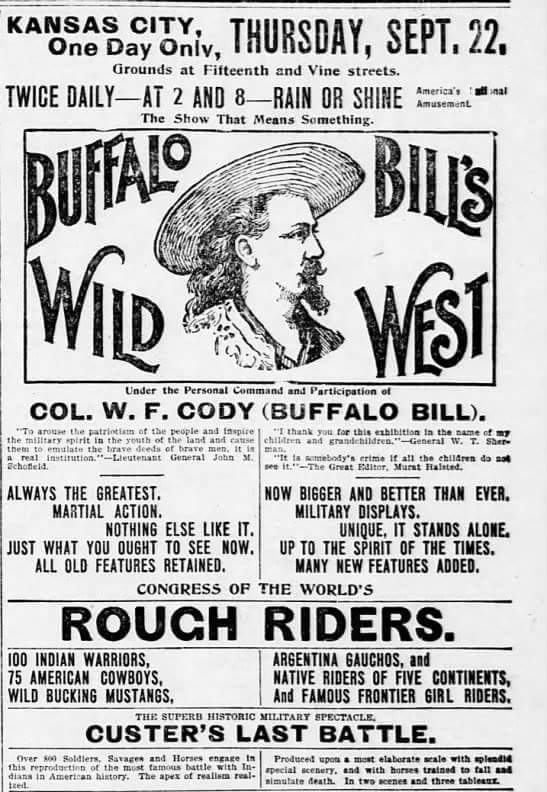
Advertisement for Buffalo Bill Wild West Show in 1898
held a short distance from Ulreich’s Kansas City home
1904-1905
Attends Central High School in Kansas City, MO. Average student but begins to show serious interest in art. Executes finely detailed watercolors of Indian chiefs, copied from color postcards.

Eduard Buk Ulreich, I Want to be a Cowboy, 1905, pen and ink, 12 ½ x 9 ½ in.
1906
Begins taking night classes in art instruction from Mrs. A.C. Muir of Kansas City.
1908
Enrolls at The Fine Arts Institute in Kansas City (later re-named the Kansas City Art Institute). Studies under Alexandra Blumberg, who studied at the Royal Academy, Dusseldorf and the Académie Julian in Paris. Blumberg had numerous exhibitions in Europe and Russia. Begins working part-time as chauffeur to help pay for school.
1909
Continues study at the Fine Arts Institute. Exhibits work along with other Fine Arts Institute students at the Findlay Gallery in Kansas City. Receives praise in the Kansas City newspaper. In an interview, he states he has never seen great original works but has studied fine reproductions. Dreams of studying and painting in the major European art centers.
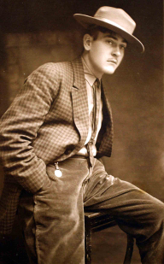
Eduard Buk Ulreich,1909
1910
Wins the 1910-1911 William L. Elkins Scholarship to the Pennsylvania Academy of the Fine Arts (PAFA) for attaining the highest merit in drawing.
1911
Chosen to study under Cecilia Beaux at the PAFA, a renowned Philadelphia artist, who studied under Thomas Eakins at the PAFA and at the Académie Julian in Paris. Works on drawing animals calling it the “language of form.” Wins commendation in anatomy drawing and the first zoological prize, the John H. Packard Award. Declares his emphasis in painting will be the one true American subject, “the western life.” Makes his first visit to New York at the end of the school year. In early summer departs with friend by train through the upper Midwest and on to an Indian reservation in South Dakota where he paints picture of Sioux Indians which wins him a scholarship for second year at PAFA. Moves further west to Wyoming, Idaho, and to Great Fall, MT seeking to meet Charles Russell. Does not return for the 1911-1912 school year. Spends the winter in Kansas City. First reference to “Buk” as a nickname by fellow PAFA students.
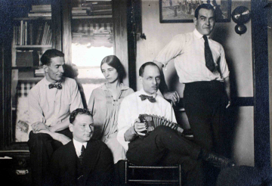
Students at the PAFA, Eduard Buk Ulreich
at far right, 1911
1912
In March, departs Kansas City on horseback, destination San Carlos, AZ. Plans to work on a ranch situated on an Indian reservation with the intention of learning about western and Indian culture. Rides 1,150 miles on horseback to El Paso, TX. Continues by train to San Carlos. Stays at the White Mountain Indian Reservation near San Carlos. Begins painting his new environment, including the wild horses. Notified that his scholarship for 1911-1912 is extended for use in the 1912 -1913 school year.
1913
Wins Cresson scholarship from PAFA to spend the summer studying abroad. Visits the major museums and galleries in Cassel, Leipzig, Dresden, Berlin, Prague and Nuremberg, though most impressed with Munich as a great art center. In his letters Ulreich talks about the powerful vision of the “Germans,” likely referring to the Blue Rider Group of German Expressionists and its most prominent representatives, Franz Marc and Wassily Kandinsky. He also visits Paris where the Cubist, Fauvist and the Surrealist movements are flourishing, featuring the works of Pablo PIcasso, Henri Matisse, Giorgio de Chirico, Marc Chagall and many other emigres whose work becomes known as the School of Paris. Ulreich sails from London to New York in September to return to the PAFA.
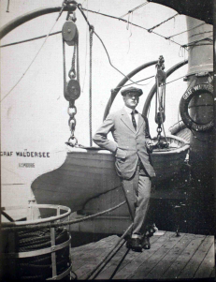
Eduard Buk Ulreich on the Graf
Waldersee sailing for
Europe, 1913
1914
Self-portrait accepted in the PAFA annual exhibition. Wins the Cresson traveling Scholarship for a second time. Sails for Europe in June. Spends extended time in Spain absorbing Spanish culture. Trip is interrupted by outbreak of World War I, heads south into Italy instead of planned return visit to Munich. Returns to the U.S. in September.
1915
Designs and carves frames to earn income. Competes unsuccessfully for the Charles Toppan Prize for composition. Completes his studies at PAFA.
1916
Participates in Americanization through Art exhibition in Philadelphia in January, featuring a portrait study. Exhibits three pictures in an Exhibition of the Artists of Kansas City and Vicinity in April. Participates in an exhibition in Kansas City by the Neo-Fantasionists, a group of Kansas City area modernist painters. Teaches poster advertising design at a new, modernist art school in Kansas City, the Artist’s Guild.
1917
Returns to Philadelphia late in February. Encouraged by friends, goes to New York in March and sets up a temporary studio. Writes to family that Socialism is one solution for peace and prosperity. Finds no steady work for balance of year.
1918
Decides to specialize in western illustration (which may lead to work) on advice of a local teacher. Works part time as a stage designer and makes posters to stimulate ship-building. Serves for about two months in the army at a base on Long Island, NY. Army stint ends early at the conclusion of WWI.
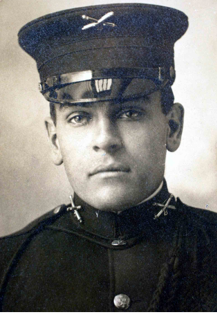
Eduard Buk Ulreich, 1918
1919
Travels to visit family in Kansas City, MO before reaching destination of Globe, Arizona, where he lives the life of a cowboy for several months in the fall. Moves to Los Angeles. Begins portraits of modern dance artists Ruth St. Denis, Ted Shawn, and Martha Graham.
1920
Executes a frieze for the interior of the Dennishawn Dance Studio. Completes portraits of St. Denis, Shawn, and Graham. In partial payment for portraits, receives modern dance instruction. Moves to Loraine, OH and partners with former PAFA classmate to decorate churches. Moves to Chicago and meets William Perrin, an art director at J.Walter Thompson Advertising who hires Ulreich for numerous commercial assignments.
1921
Ad appears in the Saturday Evening Post for the Wadsworth Watch Case Co. Does work for Burlington Railroad, enticing people to travel west with his western scenes. Decorates his new studio in Chicago in a Spanish style to showcase his work. Meets Nora G. Woodson in July, also an artist. Prepares for The American Show at the Chicago Art Institute, but work is refused, including a portrait of friend, Martha Graham. Organizes an alternative exhibit, the Salon des Refuses (The Exhibition of the Refused). Marries Woodson (“Nura”) on December 10.
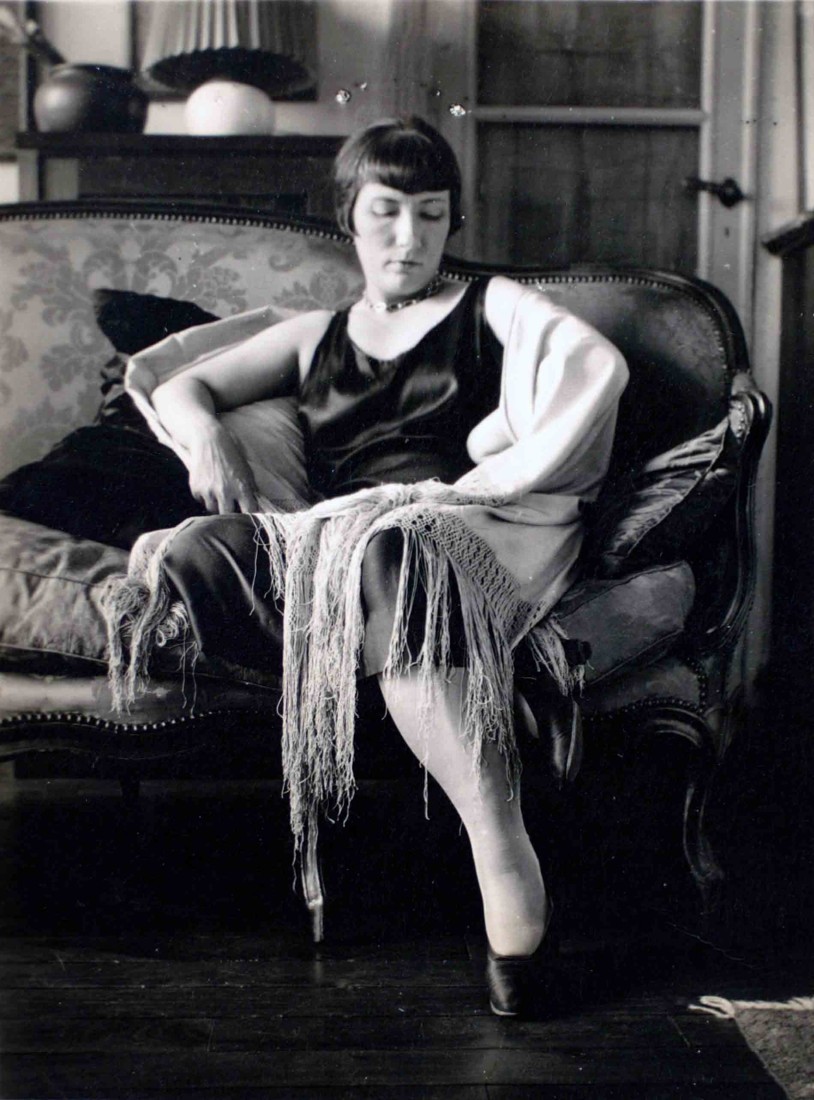
Eduard Buk Ulreich’s new wife, Nura, 1921
1922
Work appears on cover of Fashion Art magazine in January. Two pictures are accepted for a new Chicago Art Institute exhibit. Encouraged by Nura, continues advertising work while building his collection to stage future exhibitions. Later in the year enters four watercolors in the Second International Watercolor Exhibition at the Chicago Art Institute; three of the four are accepted. First exposure to the Christian Science religion by Nura; searches for enlightenment and understanding. Paints mural for the Black Cat Room of the Edgewater Beach Hotel and with Nura plans a “Spanish Ball” in December to celebrate the opening and to showcase his work.
1923
Participates in the Chicago Art Institute’s Twenty-seventh Annual Exhibition By Artists of Chicago and Vicinity, showing two pictures. Participates in Third International Water Color Exhibition, showing three pictures. Ulreich and Nura move to New York. Gets illustration work for Harper’s Bazaar magazine. Sells cover illustration to Vogue magazine for the November issue. Secures one-man show at The Anderson Galleries in New York beginning in December; sells four pictures on first day. Show gets positive review by critics from the New York Herald, the New York Post, and the Minneapolis Tribune. Western scenes are dominant from the “cowboy artist” but the “masterpiece” is My Faun and Me, not western, but a nymph frolicking in the forest.
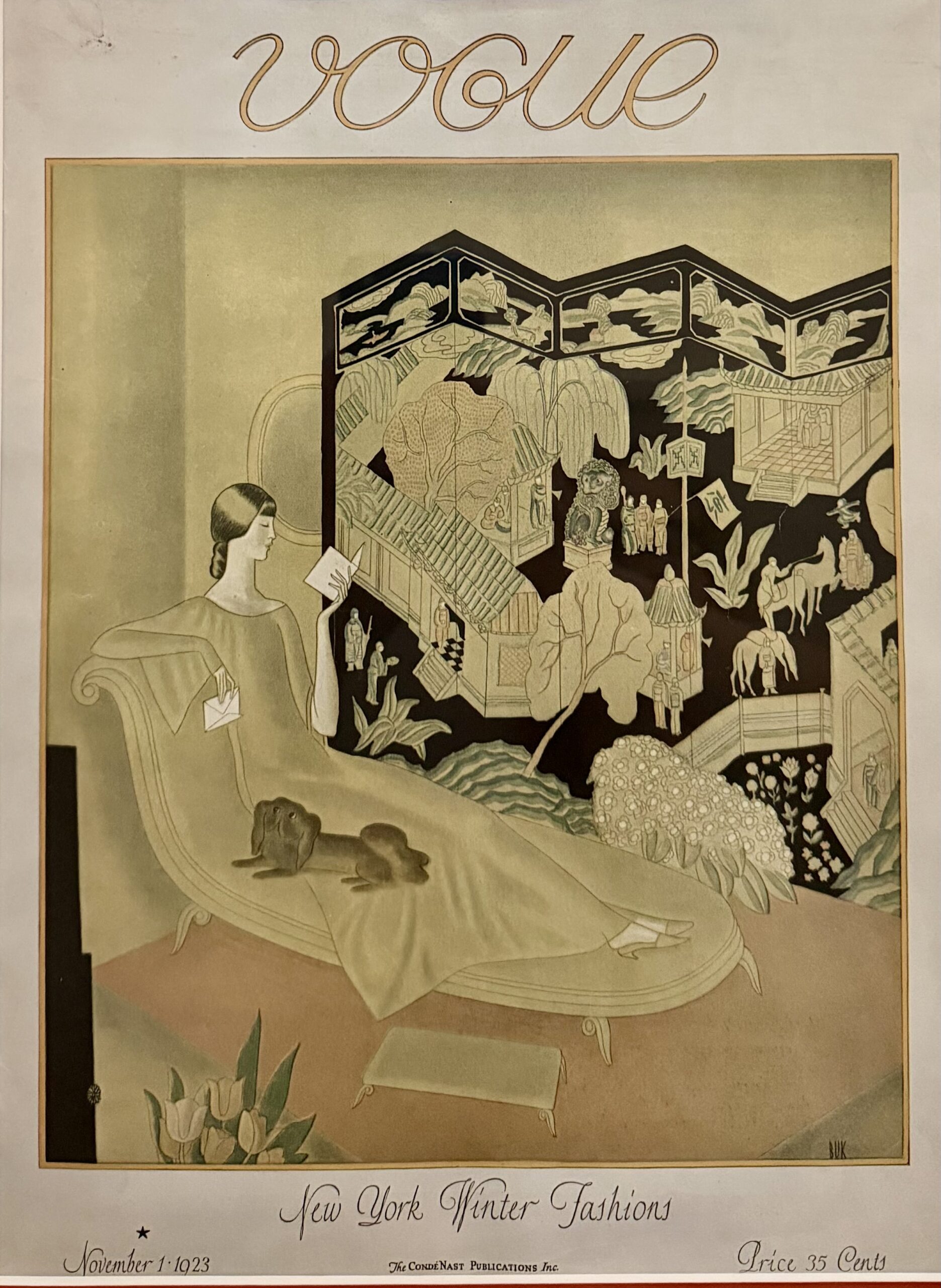
Eduard Buk Ulreich, Vogue Magazine Cover, 1923
1924
Anderson Galleries exhibit closes after selling 14 paintings. Remainder of show is shipped to Baltimore Museum of Art in an exhibit entitled Paintings, Drawings, Sculpture by American Artists. Critics speak to Ulreich’s soaring artistic imagination. Exhibits at Nassau Hotel, Long Beach, Long Island, NY in July. Both Ulreich and Nura each have two works at the Anderson Galleries in the Salons of America exhibit. The Conrad Hug Gallery in Kansas City opens in December with an exhibit featuring Ulreich’s work. Participates with three entries in the Chicago Art Institute’s Twenty-third Annual Exhibition of Modern Decorative Art.
1925
Works on tapestry designs for the Chicago Methodist Temple. Chosen to do a one-man show at the Chicago Art Institute in March. Critics call the work imaginative and highly decorative. The Chicago Tribune art critic, Eleanor Jewett states the “works are rich in color, primitive and oriental, and distinctly original.” Sells over half of his pictures including one to the Institute’s art director. Participates in the Fifth International Water Color Exhibition at the Chicago Art Institute in May. Paintings and drawings at Conrad Hug Gallery in Kansas City become focal point of a traveling lecture-exhibit in the Southwest. A particularly productive year with much exposure in galleries and exhibits, in addition to mural and tapestry work, and positive reviews from critics. Decides to go to Europe to see the International Expositions in Paris and to create more art as sales have depleted inventory. Sails for Europe in September. Rents apartment in Montmartre on the Right Bank of the Seine. Very active social life ensues including visiting galleries, dining with their many friends and socializing with artistic, musical and literary types. Arranges a one-person exhibition planned for March 1926 at the Bernheim Jeune Galleries in Paris. Declines offer to exhibit in the Anderson Gallery in New York in February 1926. Makes multiple visits to the L’Exposition des Arts Modern with particular interest in the work of artists called the Weiner Werkstatte from Austria. Featured in a story in the Paris edition of the New York Herald Tribune.
1926
In March, holds a one-person exhibition at the Bernheim Jeune Gallery. The Art News reports the exhibit is one of the successes of the season. Spanish Nights (Noche Espanol) is the featured work in the article. Following exhibition, travels to southwestern France and northern Spain and then to Annecy, near Geneva and the Alps. Conrad Hug Gallery, Kansas City, confirms a joint (Ulreich and Nura) exhibition for December 1926. Paris edition of the New York Herald Tribune runs article on pending departure of “two of the American art colony’s most interesting members.” Sails to the U.S. in November and travels to Kansas City where the critics praise the work of Ulreich and Nura. Of the exhibition at the Conrad Hug Gallery, the Kansas City Journal Post states that Ulreich’s works are “as abstract and as intangible as music,” and “strongly modernistic and primitive,” recalling Giotto, Botticelli and Piero Francesca.
1927
Exhibits at the Dudensing Galleries in New York in March. Seventeen paintings sold, one purchased for the permanent collection for the Brooklyn Museum. “My (art) interest is in primitive, spiritual things,” he states for an interview in the magazine New York American. The New York Times describes the work’s “big linear patterns and sweeping rhythms that draw many of the designs into swirling movement of complexity.” The Art News reports that “Buk makes no attempt at realism” and many works have a dream quality.” Royal Cortissoz, writing in the New York Herald Tribune says, “Buk’s emphasis (is on) the refined color in certain of his tapestried designs and on the engaging quality of his fancy, (as if) derived from Botticelli.” He weaves his romantic figures into groups that may be a little awkward now and then, but have a savor of beauty about them.” Asked to execute the interiors for new Dudensing Galleries opening in September. Participates in the new gallery’s exhibit, “Young America, Potential Leaders of Tomorrow.” Sells “Indian painting” to the Duncan Phillips, renowned modern art collector from Washington D.C. Works on award winning operatic scenes for RCA Victor advertising campaign.
1928
One-person show at the Edward Side Gallery in Philadelphia in January. The Philadelphia Ledger writes,” he (Buk) does not reproduce, he invents. (He has) the ability to balance and vary design while holding to a rhythmic and interesting general thought.” The Philadelphia Inquirer says that his themes are divided between “Indians and imaginative, symbolic decorations with equally fanciful titles.” April issue of Vogue magazine reproduces one of his paintings. Participates in joint exhibition with Nura at Macy’s New York store. Leaves for Paris in October, en route to Vienna to paint for a year.
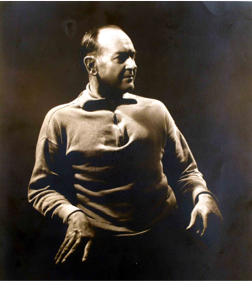
Eduard Buk Ulreich in New York, 1928
1929
Three paintings accepted to hang in the Secession Gallery in Vienna. Departs in July to travel to Budapest, Prague, Dresden, Leipzig, and Berlin. Visits Köszeg (birth place). Returns to New York in September. The stock market crashes October 29, three days before exhibit “Modern Americans” opens at the New Dudensing Galleries. Paintings fall into two categories: symbolic feminine ideas and impressions of western American life in vivid colors playing on Indian and cowboy themes. Royal Cortissoz of the New York Herald Tribune writes,” a blending of the primitive, such as one finds in the lyrical grace of a Botticelli, with the methods of an efficient modern, (leads) to a cordial acceptance of his work.” Henry McBride of the New York Sun writes that (Buk) “picked up the idea (while browsing in European galleries) “that all paintings should be beautiful. He noticed Giotto. He noticed tapestries. He noticed Piero della Francesca. His (Buk’s) “aspiration is in their (Giotto, della Francesca) direction. The Museum of Modern Art opens in November diluting some of the press coverage of the Dudensing exhibit.
1930
Buk and Nura exhibit at the PAFA in February. A New York Times article compares figures in Buk’s work, Glorious Is the Morning Sun, to those of Arthur Davies, and commends the “naturalness of this pose under the light hands of Buk.” Buk exhibits at the Walden-Dudensing Gallery in Chicago. The Chicago Evening Post praises Buk’s description of himself as a contemporary artist rather than a modern artist, knowing the label “modern” confuses and infuriates many critics and patrons. “His painting is done in his mind before he approaches his canvas.” The article also speaks to Botticelli and Florentine influences. Concurrently, has small exhibit at the Esther Markham Gallery. The New York Times reports that the series of small prints and paintings are “filled with wit, humor, buoyant irony, quick response to beauties of rhythm and scale and accent.” The show is called Happy Times. Takes job as art teacher at the Avon Old Farm School in Avon, CT in September. Participates in an advertising art show in Darien, CT. Becomes a member in AUDAC (American Union of Decorative Artists and Craftsmen) an organization which he claims is forward looking, of modern tendencies.
1931
Wins second honorable mention for Guerlain Perfume Co. advertising. Participates in AUDAC show at the Brooklyn Museum at which Ulreich has gotten wide praise. His painting, Forms, is accepted for international competition at the Carnegie Institute in Pittsburgh and draws special recognition by critics. Works on monotypes in black and white of horse studies, planning a future exhibition of same. First evidence of the emerging theme of “the horse” as a central element in future work. Horses have appeared in past paintings, but not as the central focus. horse series.
1932
Laments the ongoing economic crisis. He comments about self-sufficiency and taking responsibility for the future. (This is in stark contrast to his socialist views of 1917-18). Starting work on terra cotta horse sculptures. Father, Samuel Ulreich, dies in June. Wins competition for design for a large mural decoration, part of the upcoming Chicago Century of Progress Exhibition. The mural is “modern in spirit,” as described in the New York Herald Tribune, and consists of panels symbolically depicting American industries. Chosen in October to execute a mural for the interior of Radio City Music Hall, opening in December. Begins working in clay, modeling horses, which is later reflected in the expression of the horse figure in Ulreich’s horse series.
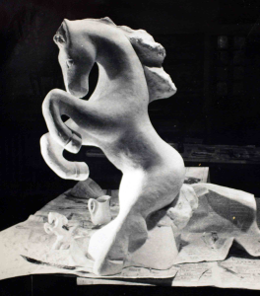
Eduard Buk Ulreich, horse casting, 1932
1933
Joint exhibit with Nura in Macy Galleries’ Autumn Exhibition of Modern Painting, Sculpture and Prints. Other works included in exhibit are by Bonnard, Braque, Matisse, Picasso, Renoir, Hopper and Zorach. Has begun to hold a sketch class once a week at his studio, and quickly expands to two nights a week. The class, orchestrated along with Nura, is part instruction, part fellowship with friends and often lasts until the early morning hours.
1934
Participates in the Thirtieth International Exhibition of Water Colors, Pastels, Drawings and Monotypes at the Art Institute of Chicago. Designs mural for the children’s ward of the City Hospital on Welfare Island, New York, entitled, Things in Nature of Interest to Infants. Begins work on mural, Evolution of the Art of Writing, for the Woodside Library in Queens. Paints Parade, which is shown at the Annual Exhibition of paintings and sculpture at the PAFA. The picture is three groupings of horses placed in a non-representational setting. (The painting is representative of later works in Ulreich’s horse series).
1935
Continues sporadic advertising commissions, which include a jewelry ad in Harper’s Bazaar and perfume ad. Sale of work has significantly slowed in the last three years. Advertising work also diminishes. Feels unproductive and looks for comfort in Christian Science. Exhibits work in first exhibition for Works Progress Administration (WPA) artists in New York. Ulreich is one of 27 invited to show work. Survey Graphic – Magazine of Social Interpretation, carries a story on the artist and his murals at the Woodside Library.
1936
Creates 50 posters for the Bureau of the Census, Washington D.C. Travels west with Nura during summer months. Participates in an exhibit at the Whitney Museum of American Art in New York showing his sketches for the Columbia, MO post office mural competition.
1937
The U.S. Pavilion of the Paris Exposition opens. Ulreich designed two 88’ panels to decorate its exterior (motifs from Indian tribes). The Paris edition of the New York Herald Tribune reports, “Brilliant murals portray lore of US Indians at Exposition.” Completes murals for post office in Columbia, MO: The Pony Express and The Stage Coach. The Kansas City Times states, “two historic murals (by Buk) are more dramatic than most of the paintings for federal buildings. Stylization has helped to give force and clarity to the idea.” Sketch classes continue at studio as a source of income and an important social outlet.
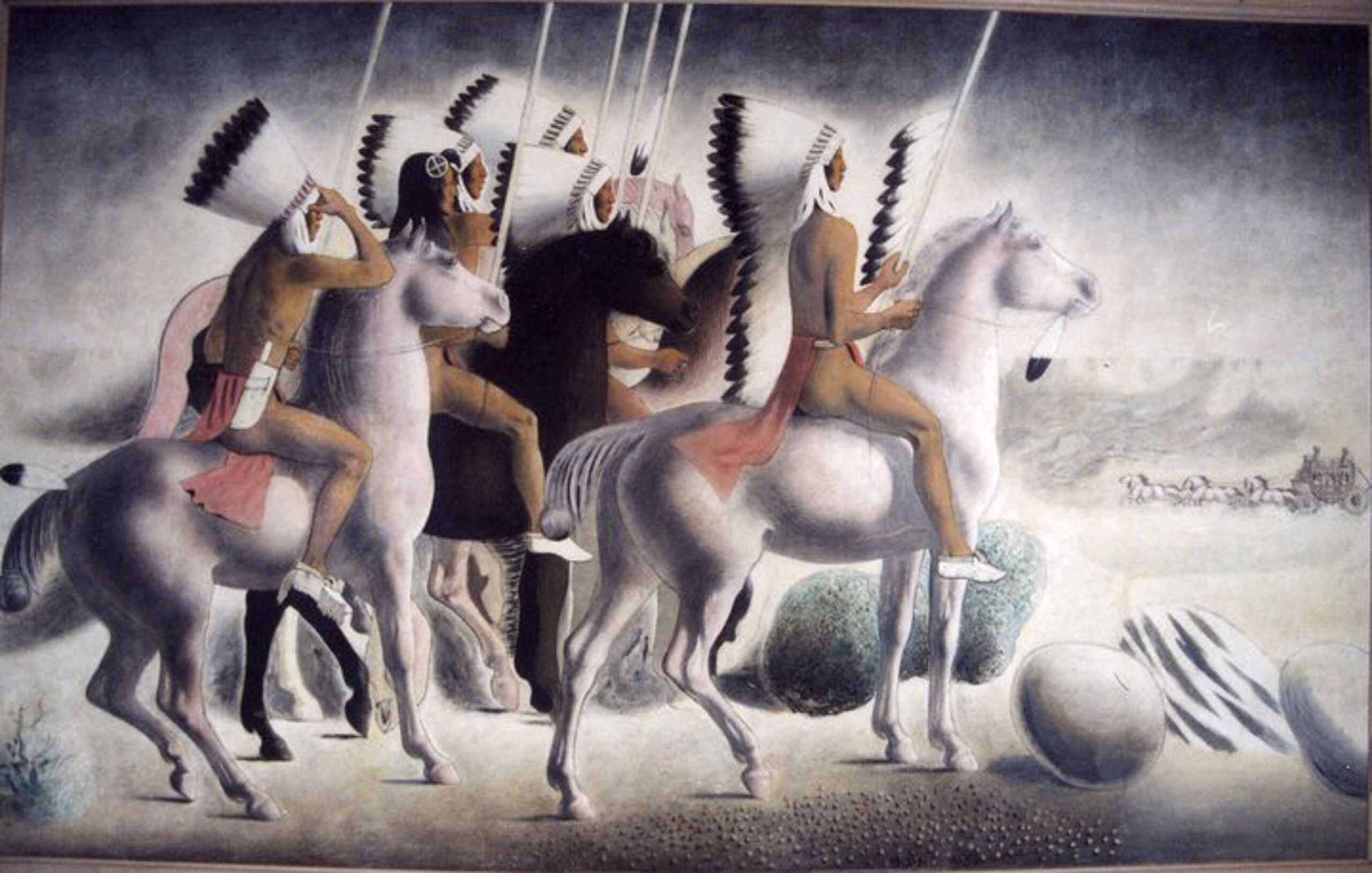
Eduard Buk Ulreich, The Stage Coach, 1937
1938-1939
Exhibits at the Art Alliance in Philadelphia. Black Beauty, Flower Garden, Before Egypt Was, and Promenade are key pieces critiqued. Horses and women are key themes. A Philadelphia newspaper writes, “In spite of a de Chirico derivative in his treatment of horses with flowing manes and tails, (Buk) has an imaginative flair all his own.” Installs murals at the U.S. Post Office in Tallahassee, FL. A Tallahassee newspaper reports “The historic material is handled with great freshness and imagination. Ulreich uses color with great strength and delicacy.”
1940
Exhibits mural sketches at the Whitney Museum of American Art. Opens one-man show at the Bonestell Galleries in New York: Indians and horses are chief subject matter, but also shows abstract designs, a major departure from earlier work. First evidence of Ulreich’s work in total abstraction. A critic writes, “A pre-eminently creative artist (who) bends his medium to his will with grace and a captivating air of ease. He likewise plays with the objective and the non-objective, often in the same design, with equal felicity. He has even borrowed de Chirico’s horses, but handle(s) them in a way that makes them entirely his own.” Western theme mural is installed in New Rockford, ND post office.
1941
Air raid alarms are tested on Saturday afternoons and New York is dark at night due to enforced black-outs. Decides to travel to Wyoming in late summer with Nura, desiring the remote and primitive life. Illustrates a children’s book, Ashkee of Sunshine Water, about Navajo Indians. Mural is installed in Concord, NC post office.
1942-1943
Enters competition for war murals but work is not chosen because as Nura describes it, “The work is not violent enough.” Regular sketch classes continue and dance instruction is introduced.
1944
Creates advertisement for TWA that is published in Time Magazine; an Indian on horseback. Caravan, the Hotel New Yorker magazine, runs article describing Ulreich’s love of horses as an artistic subject. Consternation is the cover painting, a horse abstract.
1945-1949
Leaves New York for San Diego to teach summer art classes in creative painting and illustration with Nura at The Fine Arts Gallery and the State College. The couple starts doing more activities separately, revealing discord in marriage and in 1948 they separate. In 1949 Ulreich begins teaching classes in his studio on “gaining an understanding of the art language.” Continues evening sketch classes.
1950
Nura dies on October 26, age 61. He says she was a great gift from God and “had a gift for creative expression that was divine.”
1951-1953
Finds new companion in February, Virginia McFarland, one of his students. Marries in October 1951. “Buk’s Horses,” an exhibition at the Associated American Artists Galleries, New York, opens in March 1953.
1954-1955
Moves to San Francisco with Geni (Virginia). Seeks, unsuccessfully, to do a one-person show at the San Francisco Museum of Art. In October 1955, exhibits in one-person show at the California School of Fine Arts. The San Francisco Chronicle announces “His first exhibition (in San Francisco) concerns itself almost exclusively with a single theme – the thick-necked, short legged, long-maned horses painted in every conceivable way. The result is an expression of charm and wit.”
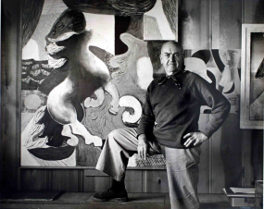
Eduard Buk Ulreich in San Francisco
studio, 1955
1956
Exhibits at the San Jose Public Library; predominant theme, horses. Hired as a guest lecturer at the San Jose Art League with intent of becoming better known in California. Reviewer states “Buk is something of a paradox. Some of his canvases – notably the decorative ones – are enormously sophisticated in style and execution while in others he seems to let technique take care of itself.” Exhibits work in the Lesser Gallery in San Francisco.
1957-1959
Exhibits at the Lion Book Shop – Gallery, San Francisco. Tension builds in relationship with Geni, due to his lack of earnings and deepening depression. Seeks help through correspondence with a Christian Science practitioner located in New York.
1960-1961
Travels with Geni to Mexico in February. In April writes again to Christian Science practioner mentioning depression and continued tension in his marriage. In 1961 Ulreich once again exhibits his work at the Lesser Gallery.
1962-1965
The San Francisco Examiner runs an article on Ulreich, highlighting his career with a reflection on his Arizona cowboy experience. Begins work on his book, Understanding of Art. Has exhibition in small gallery in Palo Alto, CA in late summer, 1962. Participates in the Annual Art Festival at the San Francisco Civic Center in 1964. Health deteriorates in the fall of 1965. Again, seeks help from Christian Science practitioner. Does not see a medical doctor.
1966
Ulreich dies July 17 at 77 while preparing for a one-man show at the Lesser Gallery. He is buried at the Golden Gate National Cemetery in San Francisco. WestArt, an art news periodical, reports, “The San Francisco art scene lost one of its most colorful figures.” Geni prepares a posthumous show of his paintings, sculptures and drawings.
1969
The Lucien Labaudt Art Gallery in San Francisco presents a posthumous exhibition of paintings by Ulreich. The cover design for the show catalogue features an abstract horse painting.